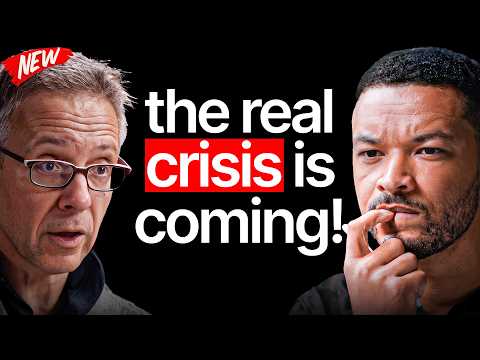
Yuval Noah Harari: An Urgent Warning They Hope You Ignore. More War Is Coming!
TL;DR
- AI represents an unprecedented threat to human autonomy and free will as it becomes capable of understanding human biology and psychology better than we understand ourselves
- The concentration of AI power among a small number of corporations and governments could create a new form of totalitarianism more effective than any historical regime
- Bioengineering and life-extension technologies could create fundamental biological divides between wealthy and poor populations, fragmenting humanity into different species
- Our educational systems and parenting approaches must shift from memorization to teaching critical thinking, emotional resilience, and the ability to navigate constant change
- Disconnecting from information overload and cultivating boredom is essential for mental health and resistance to manipulation by media corporations and algorithms
- History demonstrates that humans have faced existential challenges before, and our capacity for innovation and adaptation provides reason for cautious hope if we act consciously now
Key Moments
Episode Recap
In this provocative conversation with Steven Bartlett, historian and bestselling author Yuval Noah Harari warns that humanity stands at a critical juncture where artificial intelligence and biotechnology could fundamentally reshape what it means to be human. Harari begins by articulating his core mission: to help people understand the seismic shifts occurring in our world and to recognize that the trajectory we are currently on is not inevitable but rather a series of choices we can still influence.
Harari expresses deep concerns about AI's capacity to manipulate human behavior by exploiting our biological vulnerabilities. Unlike previous technologies, AI systems are developing the ability to understand human psychology, emotions, and decision-making processes at a level that exceeds our own self-understanding. This asymmetry of knowledge creates a dangerous power imbalance. He explores whether this signals the end of humanity as we know it, discussing scenarios where AI integration with human brains could fundamentally alter human consciousness and autonomy.
The conversation tackles the question of free will in an age of AI, with Harari arguing that as algorithms become better at predicting human behavior, the very concept of free will becomes increasingly questionable. He warns that the greatest danger is not AI becoming conscious or hostile, but rather it being used as a tool of unprecedented surveillance and control by corporations and governments seeking to manipulate human choices at scale.
Harari addresses practical concerns about AI's impact on employment, financial systems, and social stability. He emphasizes that bioengineering and life-extension technologies could create new classes of superhumans and ordinary humans, potentially fragmenting humanity into biologically distinct populations. This would represent an evolutionary divergence with catastrophic social consequences.
Regarding education and preparation for the future, Harari advocates for teaching children adaptability, emotional intelligence, and critical thinking rather than rote memorization of facts that AI can access instantly. He emphasizes the importance of disconnecting from constant information consumption, arguing that boredom and offline time are essential for mental health and resistance to algorithmic manipulation.
Harari concludes with a nuanced perspective on hope. While acknowledging the genuine dangers ahead, he draws on historical examples to show that humans have navigated existential challenges before through conscious choice and collective action. The key is developing global consciousness about these threats and making deliberate decisions about the future rather than passively accepting technological determinism. He stresses that the next decade will be crucial in determining whether AI serves humanity's flourishing or becomes an instrument of control.
Notable Quotes
“AI systems are developing the ability to understand human psychology better than we understand ourselves, creating an asymmetry of knowledge that is fundamentally dangerous.”
“The greatest threat is not that AI will become conscious and hostile, but that it will be used as a tool of unprecedented surveillance and control.”
“We need to teach our children adaptability and critical thinking, not just facts that any algorithm can access instantly.”
“Boredom is not a luxury. In the age of algorithms, the ability to disconnect and be bored is essential for your mental health and freedom.”
“History shows us that while we face genuine existential challenges, humans have the capacity to innovate and adapt our way through. The question is whether we will act consciously.”
Products Mentioned
Books
Sapiens: A Brief History of Humankind (10th Anniversary Edition)
Yuval Noah Harari's international bestseller exploring the history of humanity and its impact on the world, now available in an anniversary edition.
View on Amazon →
Health
Huel
Complete nutritional food replacement providing balanced macronutrients and micronutrients for convenient daily nutrition.
Visit Site →
Wellness
Eight Sleep
Smart sleep technology platform offering temperature-controlled mattress covers and sleep tracking for optimized rest and recovery.
Visit Site →