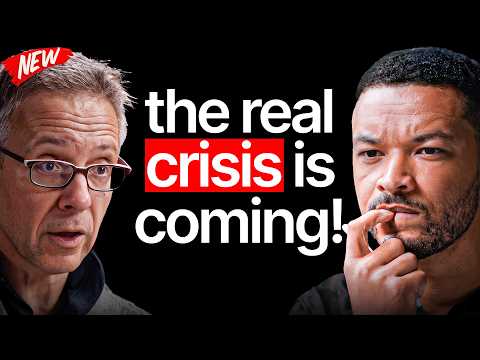
Financial Crash Expert: In 3 months We’ll Enter A Famine! If Iran Doesn’t Surrender It's The End!
TL;DR
- The Strait of Hormuz controls 20% of global oil supply, and its closure could trigger food price doubles and fertilizer shortages worldwide
- Five potential war scenarios range from Iran's destruction to nuclear escalation, each with dramatically different economic consequences
- Food prices and fertilizer availability are the critical vulnerabilities nobody is discussing in current geopolitical analysis
- The war could accelerate wealth inequality and create a boom-and-bust cycle that triggers the next major financial crash
- Self-sufficiency and local food production may be the only reliable safety nets in an increasingly unstable global system
- AI automation threatens to eliminate half of all jobs while war diverts resources and attention from economic adaptation
Key Moments
Episode Recap
Professor Steve Keen brings his prescient economic analysis to bear on the escalating tensions between the US, Israel, and Iran, arguing that the real danger lies not in military outcomes but in economic catastrophe. The episode centers on the Strait of Hormuz, a 20-kilometer chokepoint through which 20 percent of the world's oil passes daily. If this passage closes due to conflict, the ripple effects would be devastating for global food systems, energy prices, and fertilizer availability. Keen explains that fertilizer production depends heavily on energy inputs and specific mineral sources concentrated in the Middle East, meaning any disruption cascades into agricultural collapse and food price inflation. The discussion moves through five distinct scenarios for how the conflict could unfold. The first explores complete destruction of Iran, the second examines what happens if Gulf infrastructure collapses, the third delves into the Samson Doctrine and Israel's nuclear deterrence strategy, the fourth considers whether Iran could neutralize Israel's nuclear capabilities, and the fifth analyzes the implications of Iran developing nuclear weapons. Each scenario presents different economic timelines and severity levels. Keen emphasizes that the geopolitical situation has become particularly dangerous because decision makers lack accurate feedback about their actual leverage. He suggests that advisors around political leaders often avoid delivering bad news, creating a distorted reality where leaders believe they are winning when they are actually losing. The episode connects these immediate geopolitical risks to longer-term economic trends. Keen warns that wars historically widen the gap between rich and poor because wealthy individuals can hedge against inflation and instability while ordinary people cannot. He predicts that current monetary and fiscal policies are unsustainable and that another financial crash is inevitable. The timing depends on whether this war destabilizes energy markets quickly or develops more slowly. Throughout the conversation, Keen returns to the theme of self-sufficiency as the only reliable safety net. He argues that individuals should consider local food production and reducing dependence on complex global supply chains. The episode concludes with discussion of how AI automation, combined with war-driven resource constraints, could create a perfect storm where millions lose employment precisely when the economy enters crisis. Keen suggests that universal basic income might become necessary, though he expresses skepticism about whether such policies will actually be implemented before catastrophe strikes.
Notable Quotes
“The Strait of Hormuz is a 20-kilometer gap that controls your phone, your heating, and your food”
“Nobody around Trump will tell him he's losing, and what that means for you is catastrophic miscalculation”
“Food prices could double, and the one resource nobody is talking about is fertilizer”
“Wars widen the gap between rich and poor because the wealthy can hedge against inflation while ordinary people cannot”
“Self-sufficiency might be the only safety net in an increasingly unstable global system”
Products Mentioned
Tools
Ravel Economic Analysis Software
Proprietary data analysis software used by Professor Steve Keen to predict financial crises and analyze economic systems.
Visit Site →
Books
A Modern Guide to Macroeconomics
Professor Steve Keen's foundational work challenging conventional economic theory and explaining debt-based economics.
View on Amazon →